To ensure the strength of a house’s foundation slab, the correct dosage of materials is essential. A poorly dosed slab can lead to cracks, subsidence, and ultimately compromise the stability of the entire structure. Understanding the proportions of cement, sand, gravel, and water is crucial to avoid costly repairs and safety issues.
Building professionals generally recommend a precise dosage based on the type of construction and environmental conditions. For example, for a standard house slab, a mix of cement, sand, and gravel in proportions of 1:2:3, with an appropriate amount of water, is often advised.
The essential elements for quality concrete
To achieve quality concrete, several elements must be taken into account. Concrete primarily consists of cement, aggregates, water, and optional admixtures.
Cement
Cement is the key element that ensures cohesion between the aggregates and contributes to the strength of the concrete. Used in the right proportion, it guarantees the solidity and durability of the slab. Poor distribution can compromise the integrity of the structure.
Aggregates
Aggregates, made up of sand and gravel, provide strength and rigidity to the concrete. Their role is fundamental for the stability of the slab. The recommended mix for a standard slab includes a proportion of cement sand of 1:2 and sand gravel of 2:3.
Water
Water is essential for allowing the cement to set. The amount of water must be controlled precisely. An excess can weaken the concrete, while a lack of water can prevent the proper setting of the cement. The optimal dosage between cement water is generally 1:0.5.
Admixtures
Admixtures, while optional, can enhance certain properties of the concrete. They can, for example, accelerate setting, increase fluidity, or strengthen resistance. Their use should comply with the specifics of the project.
For more detailed information and practical guides, visit déclarationexpertise.fr, where you will find a complete guide to creating a perfect slab – Fiscal.immo.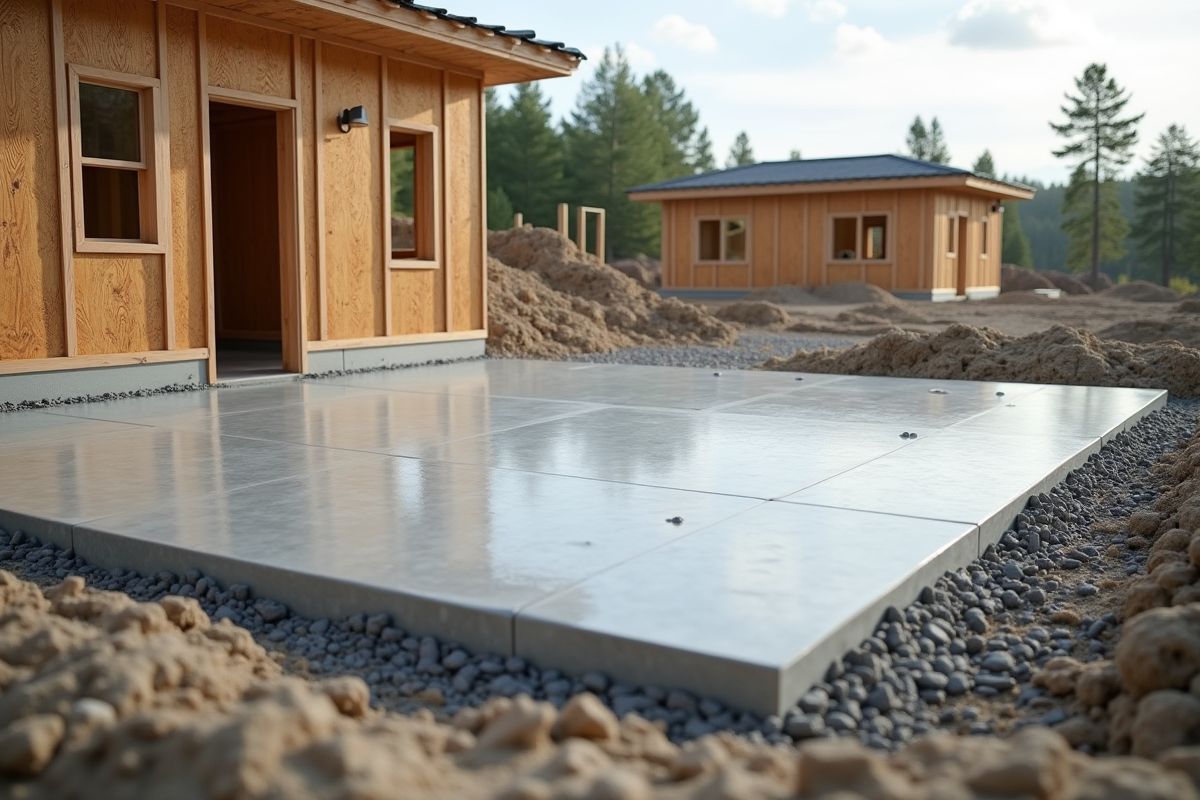
Calculating the ideal dosage for a solid slab
To calculate the ideal dosage for a concrete slab, several parameters come into play. A concrete slab, an essential structure in a construction project, requires precise dosing to ensure its strength.
The ratios to respect
The dosage must adhere to certain ratios between the different elements:
- 1 volume of cement
- 2 volumes of sand
- 3 volumes of gravel
- 0.5 volume of water
These proportions ensure good cohesion and optimal strength. The amount of water is fundamental: an excess can weaken the concrete, while a deficit prevents the proper setting of the cement.
Calculating the volume
To determine the volume of concrete needed, multiply the length, width, and thickness of the slab. For example, for a garage slab of 4 meters in length, 3 meters in width, and 0.15 meters in thickness:
- Volume = 4 x 3 x 0.15 = 1.8 m³
For 1.8 m³ of concrete, you will need approximately:
- 1.8 x 1 = 1.8 m³ of cement
- 1.8 x 2 = 3.6 m³ of sand
- 1.8 x 3 = 5.4 m³ of gravel
- 1.8 x 0.5 = 0.9 m³ of water
Using cement bags
25 kg cement bags contain approximately 0.017 m³ of cement. For 1.8 m³, you will need:
- 1.8 / 0.017 ≈ 106 bags of cement
These values are indicative and may vary depending on the specifics of the project. For more technical details and calculation tools, visit déclarationexpertise.fr.