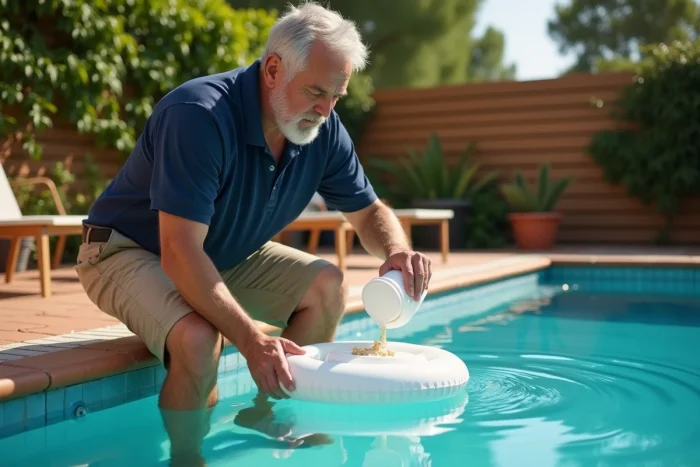
Your pool water is slightly cloudy, you have chlorine on hand and a bottle of clarifier in the technical room. The instinct is to pour everything in at once to solve the problem quickly. This combination works in certain specific cases, but it can also worsen the situation if the conditions are not met.
Compatibility between chlorine and clarifier according to the type of filter
Before discussing dosage or timing, a technical point deserves your full attention: the type of filter installed in your filtration system. It determines whether you can safely combine the two products.
Clarifiers work through polymers that agglomerate suspended microparticles. These clumps, now larger, are then captured by the filter. On a sandy or glass filter, the process proceeds normally: the aggregates remain trapped in the filtering medium and are removed during backwashing.
On a cartridge filter, the situation changes. Manufacturers like Bayrol and HTH specify in their technical sheets that certain clarifier polymers clog and damage the cartridges. If your pool is equipped with this type of filter, the question of whether to use chlorine and clarifier together deserves a cautious answer: always check the compatibility indicated on the product label.
Water pH: the parameter that conditions the effectiveness of the chlorine-clarifier duo
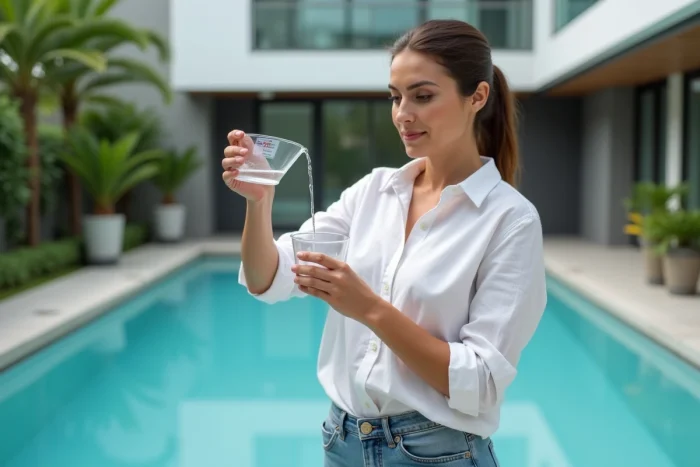
Have you noticed that the water remains cloudy despite a correct chlorine level? The pH is probably to blame. This parameter directly influences the action of chlorine and that of the clarifier, each in a distinct way.
Chlorine loses a large part of its disinfecting power when the pH exceeds 7.4. The clarifier, on the other hand, agglomerates particles less effectively outside of this same range. The result: if you combine the two in water with a pH that is too high, the effectiveness of both products drops simultaneously.
Manufacturers like Mareva and Pool Technologie indicate in their technical documentation that the chlorine-clarifier combination only yields good results when the pH is strictly between 7.0 and 7.4. Testing and adjusting the pH before any chemical intervention is not a trivial piece of advice: it is the prerequisite without which the rest is useless.
How to check the pH before treatment
Use test strips or an electronic tester. If the pH exceeds 7.4, correct it with a pH reducer and wait for the value to stabilize before adding anything else to the pool.
Shock chlorine and clarifier: why the order of application matters
When the pool water has turned (pronounced cloudiness, beginning of green coloration), many owners pour in both shock chlorine and a clarifier simultaneously. This approach poses a concrete problem.
The role of shock chlorine is to destroy organic matter, bacteria, and algae present in the water. The clarifier, on the other hand, gathers fine particles to make them filterable. If you add the clarifier before the shock chlorine has finished its destruction work, the clarifier agglomerates particles that the chlorine has not yet eliminated. You end up with clumps of partially treated organic matter, which are more difficult to filter.
The sequence that yields the best results:
- Adjust the pH within the 7.0 – 7.4 range and let the filtration run
- Perform the shock chlorine treatment, then keep the filtration running continuously for several hours until the chlorine level drops back to its normal value
- Add the clarifier once the shock chlorine has done its job and the water is no longer green but simply cloudy
This sequential approach also avoids another problem reported by professional pool technicians: the systematic use of the shock chlorine + clarifier combo causes irritations and unpleasant odors. These symptoms indicate an accumulation of chloramines, which forms when chlorine reacts with too much suspended organic matter.
When pool clarifier is not the right solution
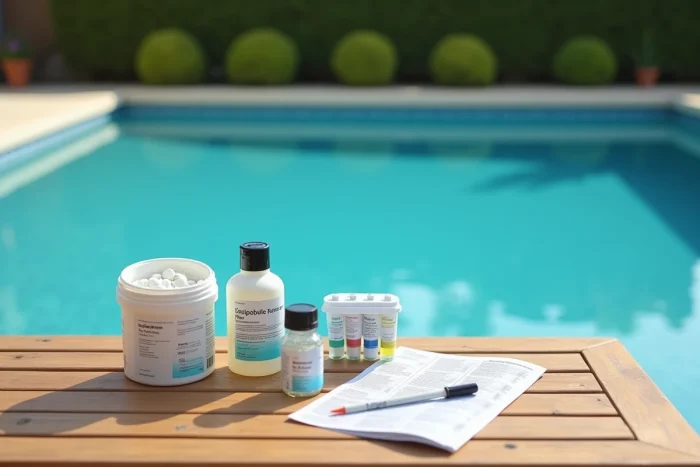
The clarifier addresses a symptom: the turbidity of the water. It does not address the cause. Before using it, ask yourself a simple question: why is the water cloudy?
If the answer is insufficient filtration time, no chemical will compensate for that. Industry professionals have noted a significant improvement in water quality simply by increasing the daily filtration duration and adjusting the pH, without adding clarifier. The product should only be used when these two levers have been activated without satisfactory results.
Cases where clarifier is unnecessary or counterproductive
- Green water with visible algae: the problem is biological, not mechanical. An algaecide treatment and shock chlorine are priorities
- Clogged filter or too short filtration time: the clarifier creates aggregates that the filter cannot capture, worsening the clogging
- Pool treated by salt electrolysis: manufacturers of electrolyzers (Zodiac/Fluidra, Hayward) report possible interactions between the clarifier polymers and the operation of the cell
In these situations, adjusting the pH and extending the filtration time resolves most cloudy water issues without requiring a clarifier.
Regular pool maintenance: reserve clarifier for real needs
The clarifier is not a regular maintenance product. Using it every week out of precaution unnecessarily overloads the filter and complicates the chemical balance of the pool. Its use is justified after a storm, exceptional pool usage, or when the water remains cloudy despite a correct pH and sufficient filtration.
Chlorine, on the other hand, remains the cornerstone of disinfecting treatment. Maintaining a stable chlorine level and a controlled pH between 7.0 and 7.4 is enough to prevent most episodes of cloudy water. The best clarifier remains well-sized filtration and properly adjusted pH.